Jev : The AI That Decides in 0.4 Seconds for $0.0004 — And Why Your Chatbot Never Could

The one-minute version
A company called TypeSafe AI launched a model named Jev on 15 September 2026. It is not a chatbot and it cannot write you an email. It does one thing: it looks at a situation and makes a decision you defined in advance, in under half a second, for a fraction of a cent.
Think of the difference this way. ChatGPT and Claude are consultants. You describe a problem, they write you an answer, and someone reads it. Jev is a decision desk. You hand it a ticket and a list of the only three things that could happen to it, and it picks one, tells you how sure it is, and moves on. It never writes a paragraph, never goes off-script, and never invents an option you did not give it.
That sounds like a downgrade until you look at the economics. A support ticket routed by Claude costs roughly 18 cents and takes about 38 seconds. The same routing decision through Jev costs four hundredths of a cent and takes 0.4 seconds, at accuracy close to a mid-tier GPT model. At that price, you stop asking whether a decision is worth an AI call and start putting judgment into every step of every process.
The founder is Diogo Almeida, who was at OpenAI and helped build the research behind ChatGPT. His argument is blunt: models have been superhuman at chat for years, so where is all the automation? His answer is that chat was never the right shape for software.
Why your AI pilots stalled

Most enterprises have the same story. The demo was brilliant, the pilot worked, and then the rollout hit a wall. Three things usually caused it, and none of them were about intelligence.
It was too slow to sit inside a process. A reasoning model thinking for 30 seconds is fine when a person is waiting for an answer. It is unusable when the decision sits in the middle of a payment flow, a fraud check, or a page load. So the AI got pushed to the edges: drafting, summarising, brainstorming. Useful, but not automation.
It was too expensive to run at volume. A pilot on 500 documents costs nothing. The same logic across 5 million transactions a month does not. Finance teams keep discovering that the per-call price that looked trivial becomes the largest line item in the project once the volume is real. So the project gets scoped down to the expensive exceptions, which is exactly where the savings are smallest.
Nobody could tell when to trust it. This is the one that quietly kills the most projects. A language model will tell you a ticket is a billing issue in the same confident tone whether it is certain or guessing. It has no reliable way of saying "I am 55% sure on this one." So you cannot build a rule that says act automatically when the model is confident and escalate when it is not. Without that rule, a human has to check everything, and if a human checks everything, you have not automated anything.
That third point is worth dwelling on because it is not a bug anyone forgot to fix. It is a side effect of how chat models are trained. They are tuned to produce answers people rate highly, and people rate confident answers highly. The training process quietly teaches the model to sound sure. TypeSafe's own documentation puts it in one line: human preference and machine trustworthiness are different targets.
How Jev is different

Jev answers only three kinds of question, and you define the possible answers before you ask.
You ask | Example | You get back |
Which one? | Which team owns this ticket: billing, technical, or sales? | One option, plus how likely each one was |
How much? | How frustrated is this customer, on a scale from calm to furious? | A position on your scale |
Is this true? | Is this invoice a duplicate of one we already paid? | A probability between 0 and 1 |
You can ask up to 255 options in a single question, and you can ask twenty questions about the same situation in one go for almost no extra time or money.

Three things follow from this design, and they are the reasons a business would care.
It cannot go off-script. If you give it three options, it returns one of those three. Not a fourth one it invented, not a half-sentence your system cannot read. In TypeSafe's own testing, Jev produced zero malformed outputs where Claude Opus 5 produced them 5.7% of the time and a GPT model 0.6% of the time. Every one of those is an exception your team has to handle by hand.
It tells you how sure it is, and the number means something. This is the real difference. Jev was trained specifically so that when it says it is 80% confident, it is right about 80% of the time. That turns into a business rule you can actually write: above 90% confidence, act automatically; between 50 and 90, send it to a person or to a more expensive reasoning model; below 50, escalate. You choose the threshold per action, so a read-only lookup can run at lower confidence than a refund.
It is honest about being unsure. Because of how it was trained, a genuinely ambiguous case comes back as genuinely ambiguous rather than as a confident guess. Your exception queue fills up with the cases that deserve a human, not with random ones.
One caution that matters and is easy to oversell. TypeSafe says Jev "can't hallucinate," and in a narrow sense that is true: it cannot make up an answer outside your list. But it can still pick the wrong item from your list. The guarantee is about format, not about being right. If your list of options is missing the correct answer, Jev will confidently pick the closest wrong one, which is why the practical advice is always to include an "other" or "none of these" option.
What it costs and how fast it is
These are TypeSafe's own published figures, from a four-workflow test covering security triage, invoice processing, customer service and reviewing what an AI agent did. Read them as the vendor's numbers, not as independent findings, for reasons I come back to below.
Jev | GPT-5.6 Terra | Claude Opus 5 | |
Accuracy | 67.8% | 67.9% | 73.1% |
Cost per decision | $0.0004 | $0.0304 | $0.1761 |
Time per decision | 0.4 sec | 10.1 sec | 37.8 sec |
Malformed outputs | 0% | 0.58% | 5.73% |
The line to focus on is the second one. Jev matches the GPT model's accuracy at one seventy-sixth of the cost, and runs 25 times faster. Against Claude Opus 5 it gives up about five points of accuracy for a 440-fold cost reduction.
What that means in a budget:
Monthly decision volume | Cost with Claude Opus 5 | Cost with Jev |
100,000 | $17,610 | $40 |
1 million | $176,100 | $400 |
10 million | $1,761,000 | $4,000 |
This is why the model is named after William Stanley Jevons, the economist who observed that making a resource dramatically cheaper increases total consumption rather than reducing it. The bet is not that you will spend less on the AI decisions you already make. It is that at four hundredths of a cent, you will start making AI decisions in a thousand places where it was never worth the money or the wait.
Two independent data points exist so far, both reported by TechCrunch. Vercel found Jev 5 to 18 times faster than an OpenAI model on a safety classification task, with better accuracy. Bryo AI found it 10 to 20 times cheaper than Gemini for email classification, but slightly less accurate. Both directionally support the claims. Neither is a full audit.
Use cases by function

The pattern to look for in your own business is any place where a person reads something and then picks from a short list. That is the shape Jev fits. Here is where it shows up most often.
Customer service and support
This is the clearest fit and the one in TypeSafe's own benchmark. Every incoming ticket needs a handful of decisions made about it before anyone does any work: which team owns it, how urgent it is, how upset the customer is, whether it is a repeat of an existing complaint, whether it mentions a legal threat, whether it qualifies for the self-service path. Today those decisions are either made by a person skimming the queue or by brittle keyword rules written five years ago.
With a decision model you ask all of them at once, in under a second, for every ticket. The confident ones route themselves. The uncertain ones land in a queue for a human, and that queue is now genuinely the hard cases rather than a random sample.
The second use is quality assurance. Most contact centres review 2% of interactions because reviewing more is unaffordable. At this price you can score every single conversation against your rubric: did the agent verify identity, was the tone appropriate, was the resolution offered, would this customer be at risk of churning. You go from a sample to a census, and your QA managers spend their time on the low-scoring ones instead of drawing them at random.
Finance and accounts payable
Invoice handling is a sequence of small judgments: does this invoice match a purchase order, is the vendor one we recognise, is this a duplicate of something paid last month, does it need a second approval under policy, is the description consistent with what was ordered. Each is a yes-or-no or a pick-from-a-list, which is exactly the shape.
One honest caveat here, and it comes from TypeSafe's own documentation. Jev is weak at arithmetic and weak at comparing dates. It scored 61.8% on the invoice workflow against 79.1% for a top GPT model, the widest gap in the benchmark. The practical design is to let your existing systems do the maths and the date comparisons, and use the model only for the judgment calls: is this description consistent, does this vendor look like the one on file, does this look like a duplicate. Give it the computed answer rather than asking it to compute.
Expense reports work the same way. Policy compliance, category assignment, and flagging the ones that deserve a look are all list-picking problems.
Security and IT operations
Security teams drown in alerts, and the cost of drowning is that real incidents get missed in the noise. Triage is a classification problem: close it, send it to an analyst, or contain it now. The same applies to IT service desks, where every ticket needs a category, a priority, and an owner.
The confidence score matters more here than anywhere else. An alert the model is 96% sure is benign can auto-close. One it is 60% sure about goes to a human with that number attached, which is far more useful to the analyst than a flat verdict.
Sales and marketing
Lead qualification, at volume and in real time. Every inbound form, every website session, every email reply can be scored for intent, fit, and urgency the moment it arrives rather than overnight in a batch. Routing follows: which rep, which segment, which sequence.
On the marketing side, this makes content moderation and brand safety affordable at full coverage. Every user-generated post, review, or comment can be checked rather than sampled.
HR and recruitment
CV screening against explicit, written criteria, with a confidence score and a full probability breakdown attached to each decision rather than an opaque yes or no. Employee survey responses can be categorised by theme at scale. Support requests to an internal HR desk can be routed the same way customer tickets are.
A warning specific to this function. Hiring decisions are regulated in most jurisdictions and the model gives you no written reasoning, only a number. Use it to organise and prioritise, keep a human making the decision, and take legal advice before it touches anything that affects someone's employment.
Operations and supply chain
Supplier communications, delivery exception notes, quality reports and maintenance logs are all unstructured text that today gets read by someone and turned into a category. Anywhere a person is doing that reading, a decision model can do the first pass.
Governing your other AI systems
This is the use case developers reached for first, according to TechCrunch, and it is the least obvious one to a business audience. If you already run AI agents or chatbots, something needs to watch them: did that answer actually come from our documentation, is the customer being told something that contradicts policy, is this request trying to manipulate the system, should this action need human approval before it runs.
Using a frontier model to check another frontier model doubles your cost and your latency. Using a cheap, fast, calibrated one to watch it is affordable at every single step. If you have an AI governance mandate and no practical way to enforce it, this is the most interesting thing on the list.
The pattern, summarised
Function | The repeated decision | What changes |
Support | Route, prioritise, detect churn risk | Queue triage becomes instant; QA goes from 2% sample to 100% |
Finance | Duplicate, policy, approval-needed checks | Exceptions surface automatically; humans see only those |
Security / IT | Close, investigate, or contain | Alert fatigue drops; confidence guides the analyst |
Sales | Qualify, score, route | Real-time instead of overnight batch |
HR | Screen, categorise, route | Consistent criteria, documented probabilities |
Operations | Classify exceptions in supplier and field text | First-pass reading is automated |
AI governance | Check the output of your other AI | Oversight becomes affordable at every step |
One ticket, start to finish

A customer writes in: "Help! My payouts have been failing for 3 days, and I was charged twice for the Pro plan. Your dashboard shows error PAYOUT_412. I need this fixed today or I am moving to a competitor."
Today, that sits in a queue until someone reads it, forms a view, tags it, and passes it on. Call it four minutes of a person's attention before any actual work starts.
With a decision model, the system asks several questions about it at once, in about four tenths of a second:
Question | Answer | How sure |
Which team owns this? | Billing | 81% |
Is this urgent? | Yes | 95% |
How frustrated is the customer? | Frustrated, not yet furious | 92% |
Is a refund likely owed? | Yes | 89% |
Is there a churn risk? | Yes | 94% |
Does it cite a specific error code? | Yes | 97% |
Then ordinary business rules, written by your team and readable by your auditors, take over.
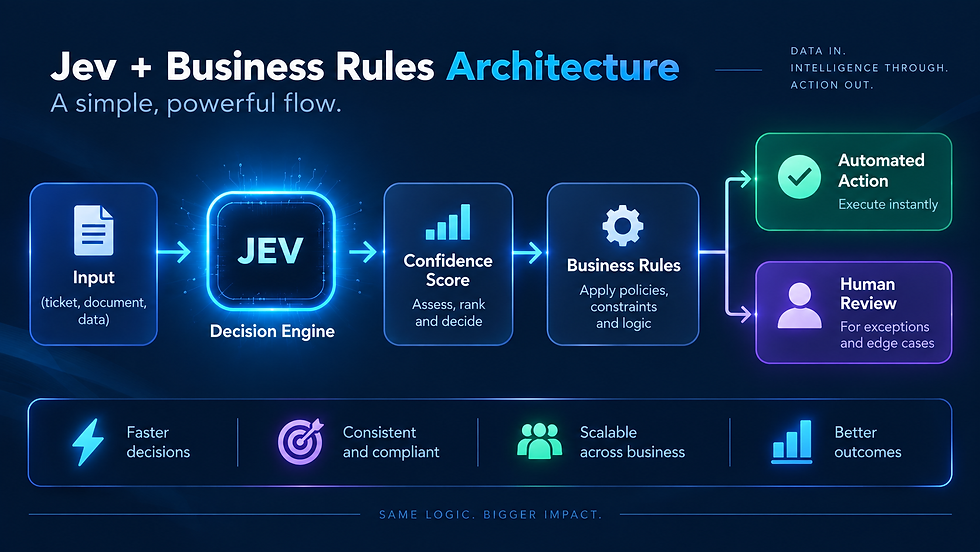
flowchart LR
  T[Ticket arrives] --> J[Decisions made<br/>0.4 sec, $0.0004]
  J --> C{How confident?}
  C -->|Above 90%| A[Route and act<br/>automatically]
  C -->|50 to 90%| E[Send to a person<br/>with the reasons attached]
  C -->|Below 50%| H[Full human review]
  A --> R[Refund flagged, billing notified,<br/>retention alerted, SLA clock started]
The refund is above the threshold, so it is flagged for the billing team with a pre-filled case. The churn signal fires a retention alert. The urgency score starts a faster SLA clock. Where the model was less sure, a person sees the question and the number rather than a silent guess.
The four minutes of triage becomes half a second, and the human time goes to the part that needed a human.
What it cannot do

TypeSafe publishes its own list of weaknesses, which is unusual and worth crediting. The short version: this is a fast, intuitive judgment model, and it has the weaknesses of fast intuitive judgment.
It cannot write anything. No emails, no summaries, no explanations, no code. If your use case ends with text a customer reads, you still need ChatGPT or Claude for that part.
It is bad at numbers and dates. It does not count reliably, it is not a calculator, and it reads dates as text rather than as points in time. Do the arithmetic in your existing systems and hand it the result.
It gives no reasons. You get a decision and a probability, never an explanation. For a regulated decision where someone has a right to know why, that is a real constraint. You can partly work around it by asking several narrow questions so the answers themselves form a record, but it is not the same as a written rationale.
It takes things literally. It answers the question you wrote, not the one you meant. Vague or doubly-negative instructions produce poor results. This is a real project cost: someone has to write the questions carefully and test them.
Long, noisy inputs hurt it. Accuracy falls when the input is padded with material irrelevant to the decision.
It does not assume bad faith. If hostile instructions are embedded in the text it is reading, it does not treat them as hostile by default. For anything customer-facing, that needs a separate control.
It is English-first and text-only. No images, no audio, no documents as pictures. Scanned invoices need to be read into text first.
A few things to weigh before committing. Jev is in early access, so availability and support are not yet enterprise-grade; the company briefly ran out of serving capacity at launch. There is no published technical paper and no independent audit of the benchmark, and notably, no published measurement of the calibration that is the product's main claim. The accuracy figures are scored against the answers of two other AI models rather than against human judgment. And it is a single vendor with one model, so this is a new dependency to think about.
The sensible reading: this is early technology with an unusually clear thesis. Pilot it on something where being wrong is cheap and recoverable, and measure the calibration yourself on your own data before you trust a threshold with anything expensive.
Bottom line

For two years the assumption has been that AI automation would arrive as a smarter chatbot. Jev is a bet that it arrives as something much smaller and much cheaper, sitting inside processes rather than in front of people, making millions of tiny decisions that nobody sees.
If that bet is right, the question for your business is not "which AI assistant should we buy" but "where in our operations is a person reading something and picking from a short list, and how many times a day does that happen." Count those, and you have your automation roadmap regardless of which vendor ends up serving it.
What to do now, in order of cost: restructure your existing AI pilots into small explicit questions rather than one big prompt, because that costs nothing and helped every model tested. Inventory your repeated classification decisions and their volumes. And if you have a high-volume, low-stakes one, run the 30-day pilot and measure the calibration yourself.
What would make this a safer bet: a published technical paper, an independent audit of the benchmark, and real calibration numbers on human-labelled data. None of those exist yet. Treat it as promising early technology, pilot it where mistakes are cheap, and keep ChatGPT or Claude for everything that needs reasoning or words.
Sources
TypeSafe AI, Introducing System One Models & Jev, 15 September 2026
TypeSafe AI, Workflow evals — the benchmark figures
TypeSafe AI documentation: confidence, models and pricing, Jev 1.13 known limitations, AI primer
TechCrunch, A new kind of AI model from a ChatGPT inventor is thrilling developers, 18 September 2026 — founders, Vercel and Bryo AI results
DataCamp, Jev: TypeSafe's System One Model — comparison table
Anthony Maio, Jev: The Language Model That Won't Talk — critical analysis
All performance and pricing figures are TypeSafe's own published numbers unless attributed otherwise. They have not been independently audited.


Comments