
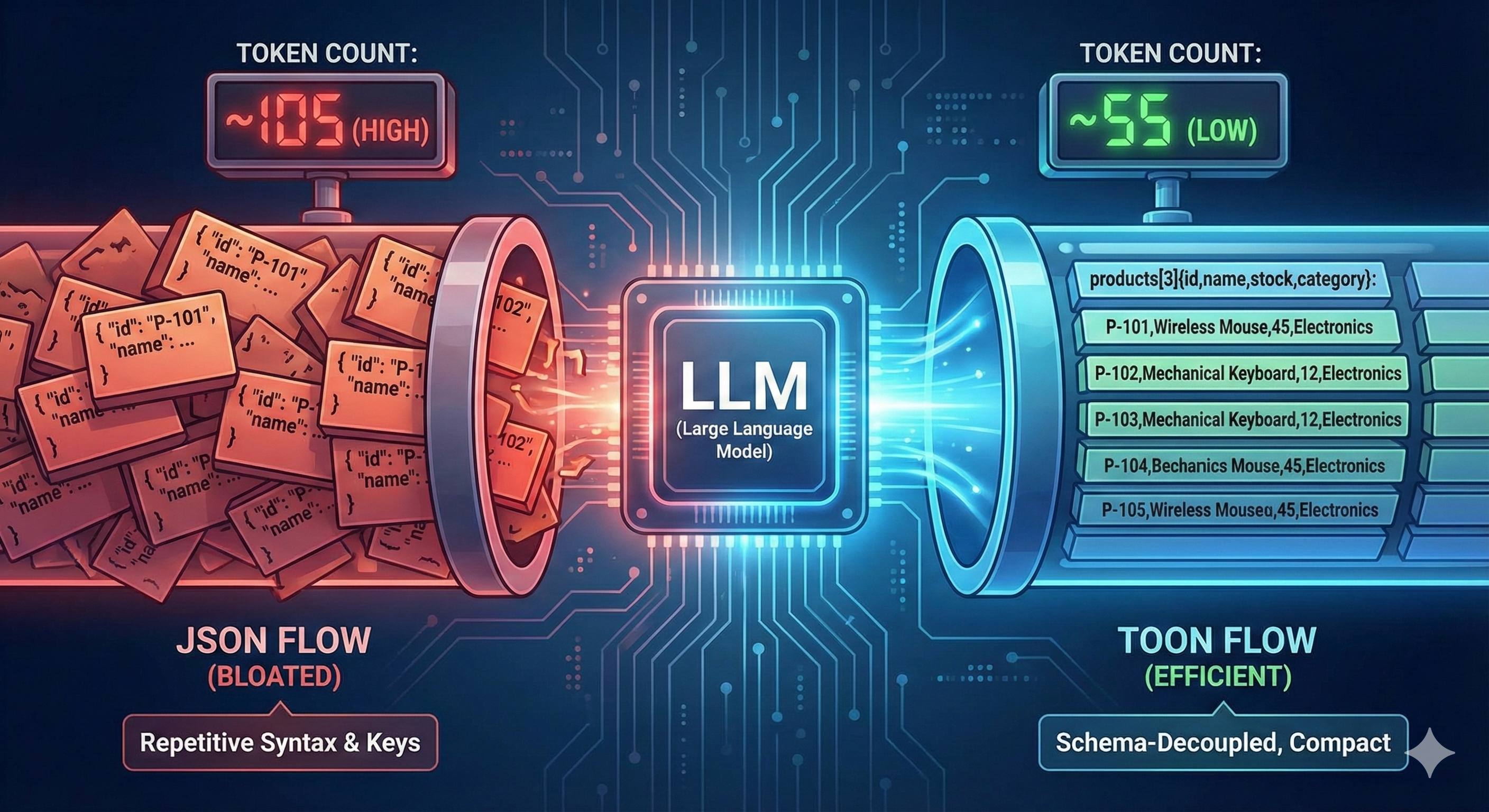
In the world of Large Language Models (LLMs), efficiency isn't just about speed—it's about "context economy." Every character fed into models like GPT-4 or Claude counts toward the context window limit and billing costs.
For years, JSON (JavaScript Object Notation) has been the standard for data interchange. It is explicit and easy to read. However, that explicitness comes with a heavy "syntax tax." When you send a list of 100 objects to an LLM, you are forcing the model to tokenize the same key names ("id", "title", "description") 100 times.
TOON (Token-Oriented Object Notation) has emerged as a solution designed to minimize this redundancy. By decoupling the schema from the data, TOON significantly reduces token counts while maintaining machine readability.
Below is a direct side-by-side comparison using a real-world dataset.
The Benchmark: Product Inventory
Let's look at a scenario where an AI agent retrieves a list of products from a database to recommend to a user. We will compare Standard JSON against TOON.
1. Standard JSON Format
In JSON, every object carries its own schema. This is robust but redundant.
JSON
{
  "products": [
    {
      "id": "P-101",
      "name": "Wireless Mouse",
      "stock": 45,
      "category": "Electronics"
    },
    {
      "id": "P-102",
      "name": "Mechanical Keyboard",
      "stock": 12,
      "category": "Electronics"
    },
    {
      "id": "P-103",
      "name": "USB-C Hub",
      "stock": 80,
      "category": "Accessories"
    }
  ]
}
Estimated Token Count (OpenAI cl100k_base): ~105 tokens
Redundancy: The keys "id", "name", "stock", and "category" are repeated 3 times. Punctuation like {, }, and " appears incessantly.
2. TOON Format
TOON borrows concepts from CSV and YAML. It declares the "shape" of the object once in the header, and then streams the values.
Code snippet
products[3]{id,name,stock,category}:
  P-101,Wireless Mouse,45,Electronics
  P-102,Mechanical Keyboard,12,Electronics
  P-103,USB-C Hub,80,Accessories
Estimated Token Count (OpenAI cl100k_base): ~55 tokens
Efficiency: The keys are defined only once. Quotes are removed (unless strictly necessary). Brackets and braces are eliminated from the data rows.
The "Token Tax" Analysis
Why is the difference so dramatic? Let's break down the tokenization of a single row.
The JSON Cost:
{ "id": "P-101", "name": "Wireless Mouse", ... }
Overhead: The tokenizer must process opening braces, closing braces, colons, commas, and quotation marks for every single field.
Result: A single row can cost 30+ tokens.
The TOON Savings:
P-101,Wireless Mouse,45,Electronics
Overhead: Only newlines and commas.
Result: The same row costs roughly 10-12 tokens.
Token Comparison Table
Metric | JSON (Minified) | TOON | Reduction |
Structure Characters | {}[]"",: (Heavy) | []{}, (Minimal) | High |
Key Repetition | Repeated per row | Once in header | 100% per row |
Data representation | Strings quoted | Strings unquoted | Moderate |
Total Tokens (100 rows) | ~2,800 tokens | ~1,200 tokens | ~57% Savings |
When to Use Which?
While the savings are impressive, TOON is not a universal replacement.
Stick with JSON when:
You are interacting with traditional web APIs or databases.
The data is highly irregular (every object has different keys).
You need strict type safety deeply nested in legacy systems.
Switch to TOON when:
Prompt Engineering: You are injecting long lists of data (logs, search results, product catalogs) into an LLM's system prompt.
RAG Responses: You are retrieving document chunks and want to fit more context into the window.
Cost Control: You are running high-volume batch processing where a 40% token reduction directly translates to a 40% bill reduction.
Summary
The "verbosity" of JSON was never an issue when bandwidth was the only bottleneck. But in the age of Generative AI, where compute and attention span are the bottlenecks, formats like TOON offer a pragmatic optimization. By moving the schema to the header, we allow the LLM to focus on what matters: the data itself.