

Large language models (LLMs) are excelling at reasoning tasks, and researchers are finding that clever prompts can push their performance even further. These prompting techniques come in two flavours:
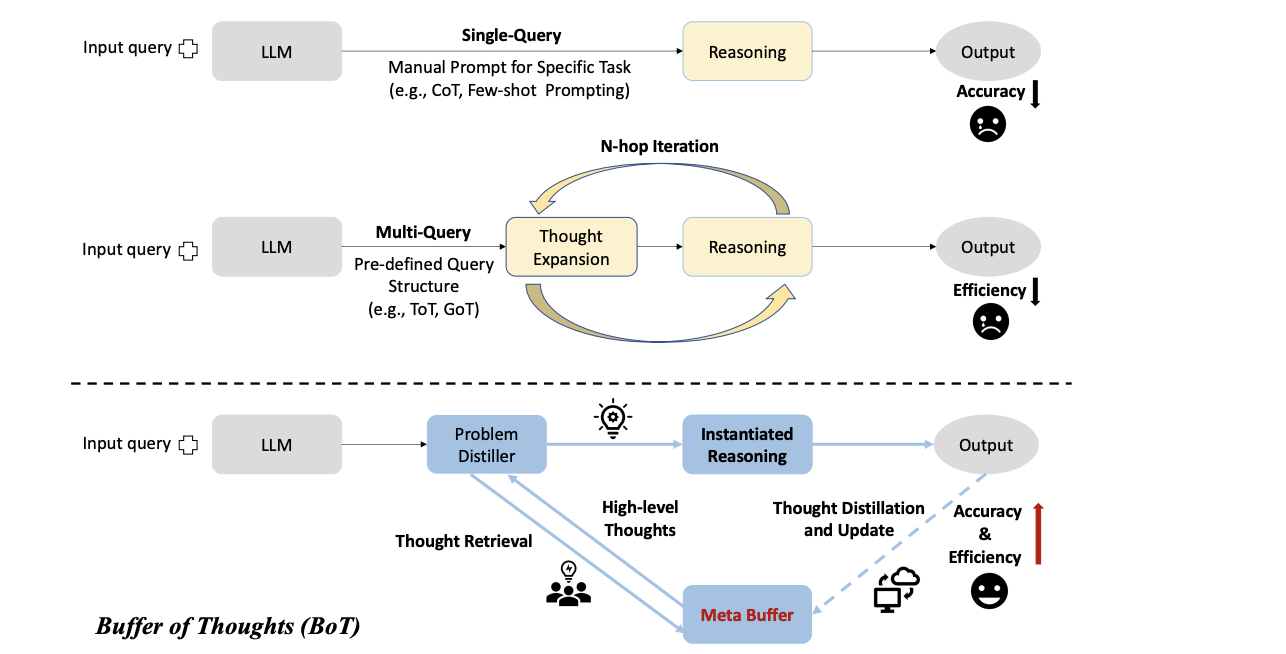
Single-query prompting: This approach focuses on crafting effective prompts that guide the LLM towards the right answer. Techniques like Chain-of-Thought (CoT) prompt the LLM to reason step-by-step, while Few-shot prompting provides relevant examples to help it generate accurate answers.
Multi-query prompting: Here, the strategy involves using multiple LLM queries to explore different reasoning paths. This can be helpful for breaking down complex problems into smaller, more manageable ones. Examples of multi-query prompting methods include Least-to-Most, ToT, and GoT.
Limitations
Single-query :
Reliance on specific prompts: These methods often need prompts tailored to each task, making them inflexible and difficult to use for new problems.
Multi-query :
Computational cost: The back-and-forth nature of multi-query approaches can be computationally expensive, especially for complex tasks.
Limited learning: Both single and multi-query methods struggle to learn from past experiences. They rely heavily on pre-designed prompts and structures, missing out on the opportunity to develop general reasoning skills that could improve performance on new tasks.
What is Buffer of Thoughts ?
Buffer of Thoughts (BoT) ,framework aims to enhance the reasoning accuracy, efficiency, and robustness of LLMs across various tasks. Specifically, a lightweight library called meta-buffer is designed. This meta-buffer houses a series of universal high-level thoughts (thought-templates) distilled from different problem-solving processes. These thought-templates can be shared across tasks. For each problem, a relevant thought-template is retrieved and instantiated with a specific reasoning structure to facilitate efficient thought-augmented reasoning. Additionally, to guarantee the scalability and stability of BoT, a buffer-manager is proposed. This buffer-manager dynamically updates the meta-buffer, effectively enhancing its capacity as more tasks are solved.
Advantages:
Improved Accuracy: By utilizing shared thought-templates, BoT can adaptively tailor high-level reasoning patterns to different tasks. This eliminates the need to constantly create new reasoning structures from scratch, ultimately leading to more accurate results.
Enhanced Reasoning Efficiency: BoT's thought-augmented reasoning leverages pre-existing, informative reasoning structures directly. This bypasses the complexities of multi-query processes, significantly improving reasoning efficiency.
Increased Model Robustness: The process of retrieving and instantiating thoughts in BoT mirrors human reasoning. This allows LLMs to approach similar problems consistently, leading to a substantial boost in model robustness.
Buffer of Thoughts has 3 main sections
Problem Distiller
meta-buffer
Buffer Manager
Problem Distiller
Challenges of Complex Reasoning Tasks:
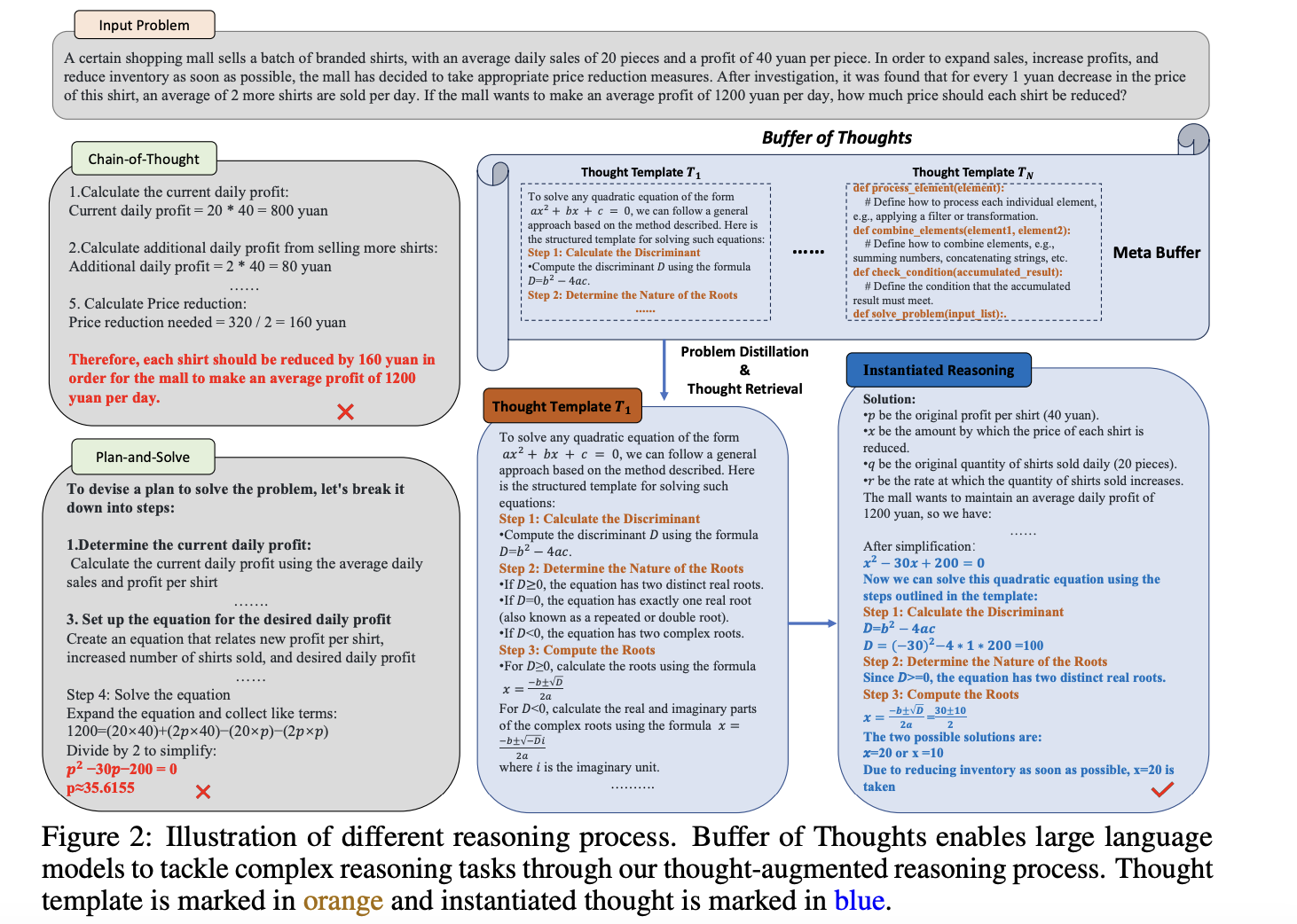
Complex tasks often present significant hurdles for LLMs due to their inherent characteristics. These challenges include:
Information Extraction: Identifying the crucial details within the context of a complex task can be difficult.
Constraint Recognition: Understanding and acknowledging the potential limitations or rules governing the task is essential.
Accurate Reasoning: Performing logical deductions and calculations based on the extracted information and identified constraints.
Introducing the Problem Distiller:
To address these challenges, a meta-prompt named φ (phi) is proposed. This problem distiller functions in two key phases:
Distillation and Formalization: φ acts to first extract and formalize the essential information from the input task. This involves focusing on:
Identifying the essential parameters and variables crucial for solving the problem.
Recognizing the objectives of the task and any associated constraints.
Information Reorganization: Once the information is extracted, φ re-organizes it into a clear and well-structured format suitable for the subsequent reasoning stage. This allows the LLM to process the information more effectively and perform accurate reasoning.
Thought-Augmented Reasoning with Meta Buffer
Thought Template
Buffer of Thoughts (BoT) relies on a core concept called thought-templates. These templates represent general reasoning patterns that can be applied across various tasks. To ensure broad applicability, BoT categorizes thought-templates into six distinct groups:
Text Comprehension
Creative Language Generation
Common Sense Reasoning
Mathematical Reasoning
Code Programming
Application Scheduling
The system stores these thought-templates within a dedicated component called the meta-buffer. This lightweight library serves as a central repository for these reusable reasoning patterns.
Template Retrieval
To tackle each new challenge, BoT employs a strategic retrieval process. It searches its library of thought-templates (Ti) to identify the one that best aligns with the problem at hand (xd). This selection process involves calculating the embedding similarity between the description of the thought-template (DTi) and the distilled representation of the problem (xd). Essentially, BoT compares the characteristics of each template to the information extracted from the current task and selects the most fitting one for the specific reasoning required.
Instantiated Reasoning
When dealing with a specific task, BoT approaches the reasoning process through "instantiated reasoning." This involves adapting a retrieved thought-template to the specific problem at hand. There are two main scenarios to consider:
Existing Thought-Template Found: In the ideal case, BoT successfully retrieves a relevant thought-template (Tj) from the meta-buffer that closely aligns with the current task. This retrieved template then serves as the foundation for the reasoning process.
New Task Encountered: However, BoT may encounter entirely new tasks for which there isn't a perfectly matching template in the meta-buffer. To address this challenge, BoT maintains a set of three general, coarse-grained thought-templates. These templates represent broad reasoning approaches that can be applied to a wider range of problems. By analyzing the distilled task information (xd), BoT can automatically select the most suitable coarse-grained template and utilize it for the reasoning process. This ensures that even for novel tasks, BoT can leverage a foundational reasoning structure to guide problem-solving.
The Learning Engine: Buffer-Manager
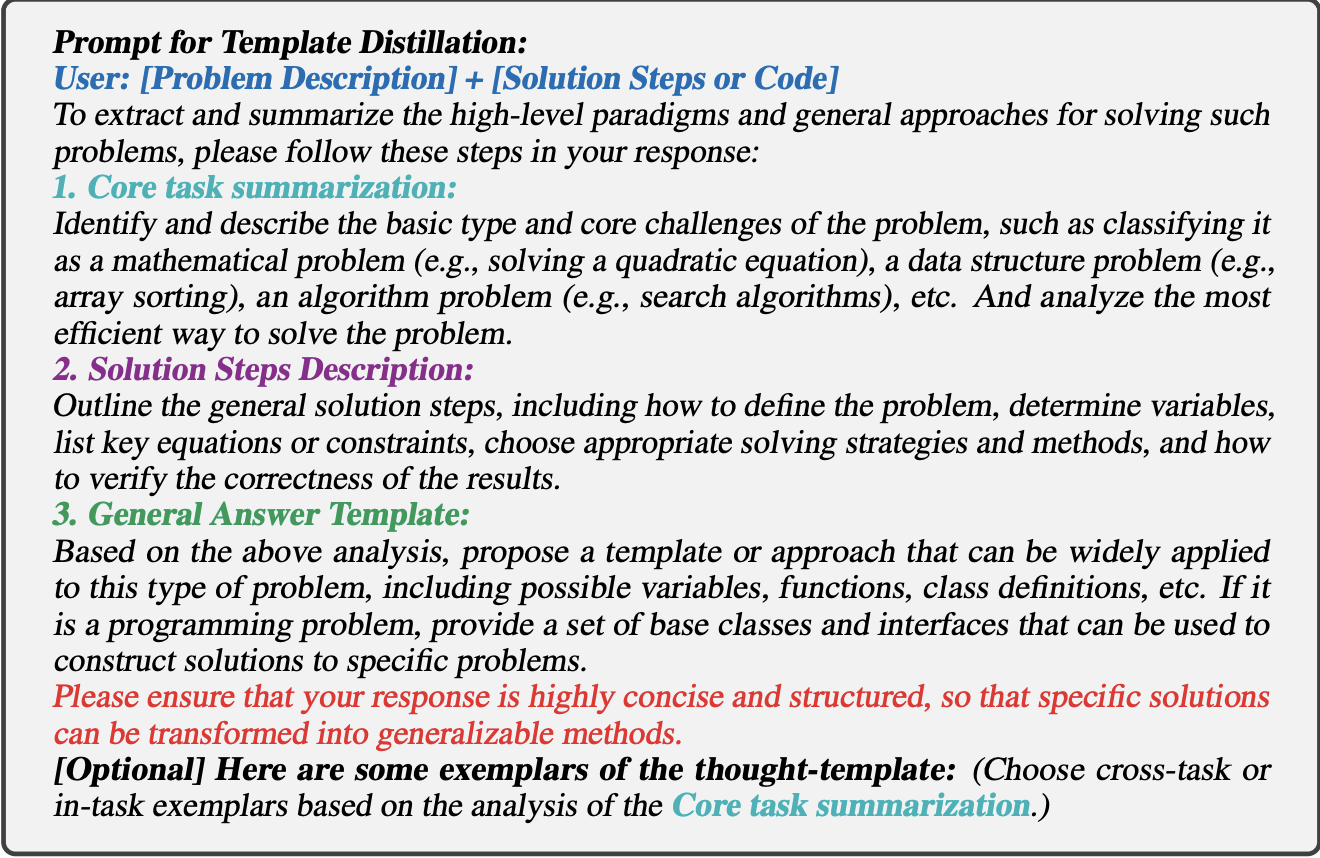
BoT's innovation lies in its buffer-manager, a component that goes beyond simply storing past solutions. This intelligent module acts as a learning engine, actively analyzing the reasoning processes used to solve each task. Here's how it works:
Extracting High-Level Insights: The buffer-manager dissects each problem-solving process to extract valuable high-level reasoning patterns and generalizable thought structures.
Generalization from Specifics: Instead of storing temporary solutions specific to each task, the buffer-manager focuses on capturing the core reasoning principles. This allows it to generalize these insights and apply them to a broader range of problems.
Knowledge Accumulation: Distilled Thought-Templates: The extracted high-level guidelines and thought structures are then distilled into reusable thought-templates. These templates encapsulate the essence of successful reasoning strategies and become part of the meta-buffer.