
Introduction
The release of GPT-5 marks a defining moment in the evolution of large language models. Building on the breakthroughs of its predecessors—GPT-4, GPT-4o, and GPT-4.1—GPT-5 is more than just a model upgrade; it’s a unified intelligence system designed for speed, reasoning depth, and unprecedented context handling. With up to 400K tokens of total context capacity, enhanced tool integration, and adaptive model routing, GPT-5 pushes the boundaries of what’s possible in natural language understanding, code generation, and agentic AI workflows.
For developers, GPT-5 is not simply about higher benchmark scores—it’s about delivering consistent, reliable performance across a wider range of real-world tasks, from managing vast documents to executing multi-step reasoning chains with remarkable accuracy. This introduction of new developer controls, multimodal capabilities, and intelligent task allocation sets GPT-5 apart as the most versatile and capable AI model yet from OpenAI.
GPT-5 vs Its Predecessors
Over the years, OpenAI’s GPT series has evolved from basic text generation to sophisticated, multi-modal reasoning systems. Each generation brought significant improvements in accuracy, speed, context length, and tool integration—but GPT-5 represents a fundamental architectural shift.
1. Architectural Evolution
GPT-3 introduced large-scale text generation, but lacked advanced reasoning and had a limited context window of ~2K tokens.
GPT-4 expanded the context window to 8K–32K tokens and improved reasoning, but still required users to manually choose between different variants for speed or accuracy.
GPT-4o pushed into multimodal territory (text, image, audio), supporting 128K tokens and improved latency for real-time interactions.
GPT-4.1 showcased 1M-token context capacity, targeted at specialized, ultra-long-document use cases, but it was a niche deployment.
GPT-5 unifies these strengths—offering 256K input tokens (400K total in API), automatic routing between fast and reasoning models, and persistent performance even at high token counts.
2. Performance Gains
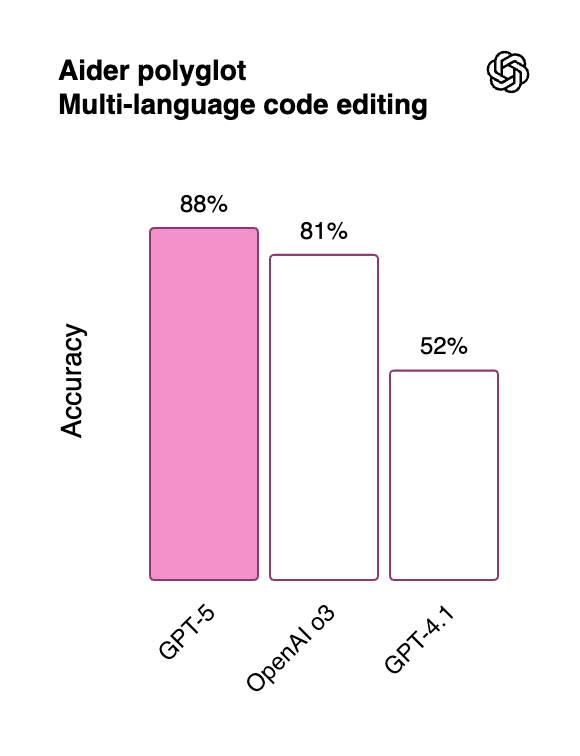
On standard industry benchmarks, GPT-5 consistently outperforms its predecessors:
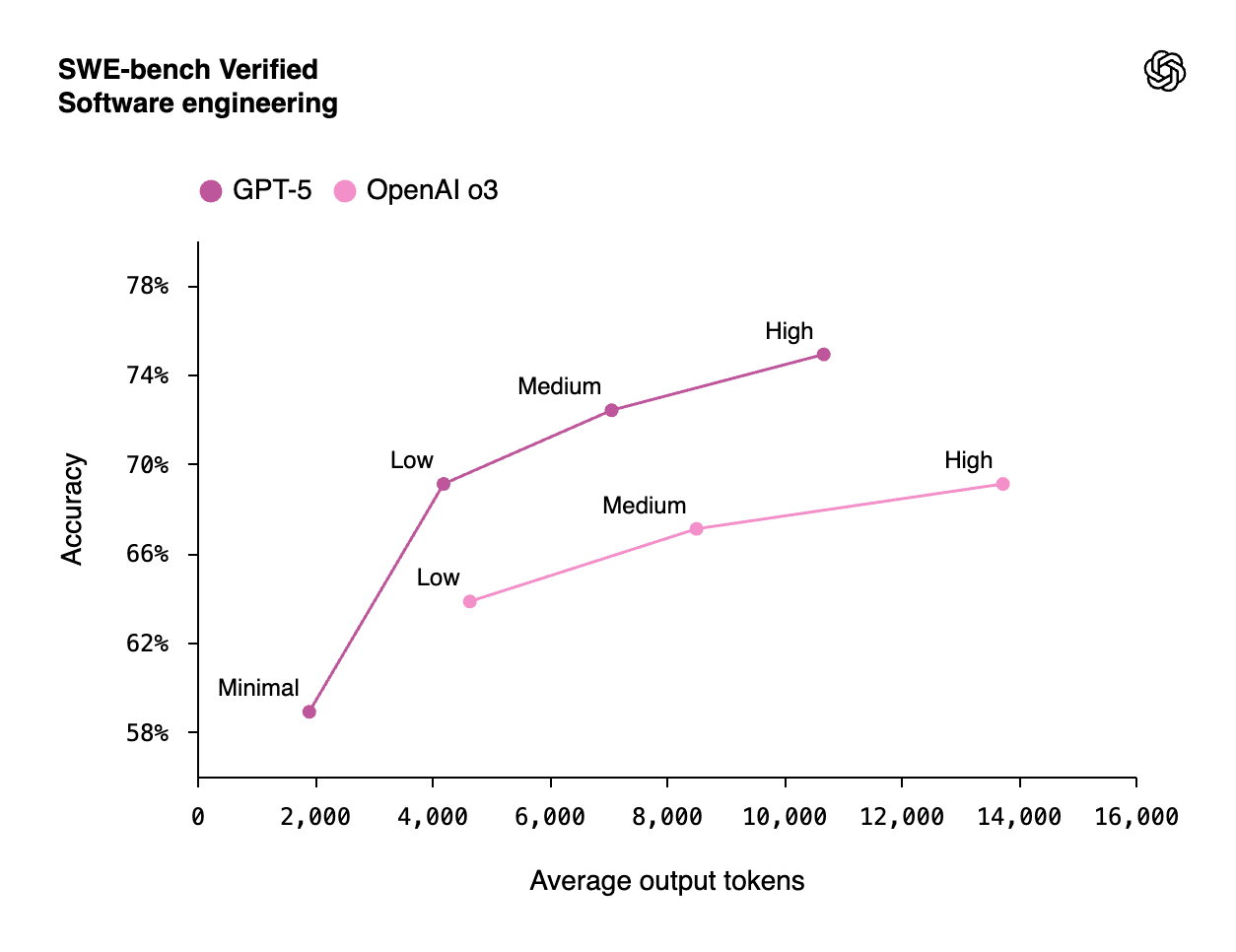
SWE-bench Verified: 74.9% vs GPT-4o’s 69.1%
Aider Polyglot: 88% vs GPT-4o’s ~84%
τ²-bench (tool chaining): 96.7%, a leap over earlier models.
These numbers reflect not just incremental gains, but improved efficiency—fewer tokens consumed, fewer tool calls needed, and more reliable accuracy on long tasks.
3. Developer Experience
In prior generations, developers often had to balance speed vs reasoning depth manually. GPT-5 eliminates that friction:
A real-time router picks the best sub-model for the task.
New verbosity and reasoning_effort controls let developers fine-tune output depth without writing extra prompt logic.
Tool calling now supports flexible grammars, making it easier to integrate GPT-5 into complex workflows.
In short, GPT-5 doesn’t just outperform—it changes how developers and enterprises interact with large language models.
Unified Architecture with Intelligence
Unified System: GPT-5 functions as a seamless ensemble—comprising a fast, high-throughput model for routine tasks, a deeper “GPT-5 thinking” model for complex challenges, and a real-time router that dynamically selects the optimal pathway based on task complexity, user intent, or tool requirements. When usage thresholds are reached, lighter “mini” versions step in, ensuring seamless continuity.
Developer Controls: It introduces nuanced control knobs—verbosity (low, medium, high) and reasoning_effort (e.g., minimal to high)—alongside support for free-form function calling and context-free grammars for enhanced flexibility and tool integration.
Performance Across Domains
Coding: GPT-5 sets new records—scoring 74.9% on SWE-bench Verified and 88% on Aider Polyglot.
Reasoning & Tools: It achieves 96.7% on τ²-bench (telecom), significantly higher than its predecessors.
Long-Context Recall: On OpenAI-MRCR, it clocks 95.2% accuracy at 128K input tokens and 86.8% at 256K. On BrowseComp (128K), it delivers 90% accuracy.
Academic & Multimodal Benchmarks: New heights across math (94.6% AIME 2025), multimodal understanding (84.2% MMMU), and health (46.2% HealthBench Hard).
Context Length in Detail
One of the most transformative features of GPT-5 is its expanded context capacity—the amount of information it can process in a single interaction without losing track. Context length directly impacts how well a model can reason across long documents, multi-step dialogues, or massive datasets without repeated summarization.
1. GPT-5’s Context Window
API: Supports up to 400K total tokens—commonly 272K tokens for input and 128K tokens for output in a single request.
Chat Interface:
Free tier: ~8K tokens
Plus tier: ~32K tokens
Pro/Enterprise: up to ~128K tokens
Long-Context Performance:
At 128K tokens, GPT-5 scores 90% on BrowseComp and 95.2% on OpenAI-MRCR.
At 256K tokens, accuracy remains 86.8%—a strong showing at extreme input lengths where many models degrade sharply.
2. How It Compares to Predecessors
Model | Max Context Window (Tokens) | Notable Traits |
GPT-3 | ~2,048 | Limited reasoning & memory |
GPT-4 | 8,192 / 32,768 | Stronger reasoning, larger working memory |
GPT-4o | ~128,000 | Multimodal, lower latency |
GPT-4.1 | 1,000,000 | Niche ultra-long document support |
GPT-5 | 256,000 input + 128,000 output (API) / 400K total | High accuracy even at large token counts |
While GPT-4.1 technically supports the largest raw token span, GPT-5’s practical usability at large context sizes makes it far more versatile for everyday and enterprise-scale workloads.
3. Why Large Context Matters
End-to-End Processing: Enables the model to handle entire codebases, books, or multi-year conversation logs without chunking.
Higher Reasoning Consistency: Maintains logical flow across long sequences—critical for legal analysis, research synthesis, and multi-stage problem-solving.
Reduced Prompt Engineering Overhead: Fewer workarounds are needed to feed the model the right background information.
4. Developer Implications
For teams building AI-powered apps, GPT-5’s context length means:
Fewer API calls (cost savings & lower latency)
Better grounding in user-specific data
Simplified architecture for agents that need persistent memory over long sessions
Key Takeaways & Closing Thoughts
The arrival of GPT-5 is more than an incremental upgrade—it’s a structural leap in how large language models operate, reason, and integrate into real-world systems.
What sets GPT-5 apart:
Unified Intelligence System – Automatic routing between fast and reasoning models eliminates manual trade-offs between speed and depth.
Expanded Context Capacity – Up to 400K total tokens in API calls allows GPT-5 to handle projects, conversations, and datasets that previously required multiple passes.
Developer-Centric Controls – Parameters like verbosity and reasoning_effort, plus flexible tool calling, give developers granular control without complex prompt engineering.
Benchmark Leadership – Consistently higher scores in coding, reasoning, and tool integration benchmarks while consuming fewer tokens and API calls.
Real-World Reliability – Maintains strong accuracy even at 128K–256K tokens, ensuring dependable performance for enterprise-grade workloads.
Bottom line: GPT-5 isn’t just the next step in OpenAI’s model lineup—it’s a platform built for scalable, context-rich, reasoning-heavy applications. Whether you’re an enterprise integrating AI into mission-critical systems, a researcher working with vast datasets, or a developer building intelligent agents, GPT-5 offers the flexibility, speed, and intelligence to take your applications to the next level.
As context lengths grow, benchmarks rise, and integration features deepen, GPT-5 positions itself as the go-to model for the next generation of AI-powered solutions.