
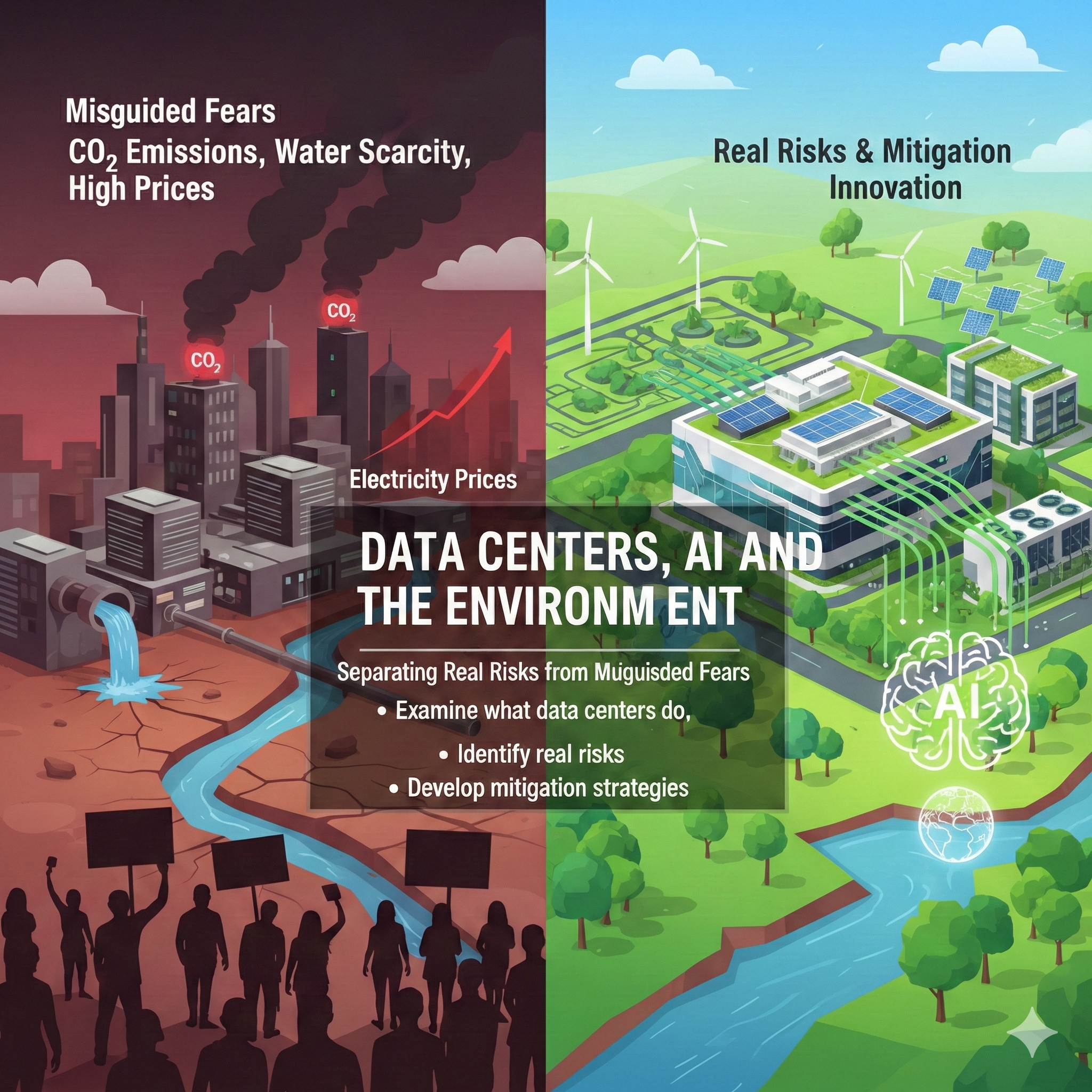
As AI adoption accelerates, data centers are increasingly at the center of public debate. Critics argue that new data centers will increase CO₂ emissions, electricity prices, and water consumption, and in some regions, these concerns have triggered strong opposition.
These concerns are not imaginary — but they are often incomplete.
To make good policy decisions, we need to move beyond headlines and examine what data centers actually do, where the risks are real, and how they can be mitigated.
Why the Concern Exists
Modern data centers — especially those powering AI workloads — are energy-intensive. They require:
Large, continuous electricity supply
Significant cooling (sometimes water-based)
Grid infrastructure upgrades
In poorly planned regions, this can lead to:
Increased reliance on fossil fuels
Local grid congestion
Stress on water-scarce communities
These risks deserve serious attention.
What’s Often Missed in the Debate
Recently, Andrew Ng highlighted a critical but overlooked point:
If computation must happen, centralized data centers are often the most energy-efficient way to do it.
Here’s why that matters.
1. Efficiency at Scale
Hyperscale data centers routinely operate at PUE levels near 1.2 or lower, meaning far less energy is wasted compared to fragmented, on-premise or legacy infrastructure.
In many cases, one modern data center replaces thousands of inefficient server rooms.
2. Per-Unit Impact vs Absolute Impact
Yes, total electricity usage is rising — but energy per computation is falling rapidly due to:
Better hardware (GPUs, TPUs)
Model optimization
Smarter cooling and scheduling
Blocking efficient data centers can push compute into less efficient, more carbon-intensive alternatives.
3. Electricity Prices Are Not Always Driven Up
In some regions, large data center loads:
Help amortize grid infrastructure costs
Improve grid utilization
Enable new renewable investments
Electricity prices rise mainly when planning and cost allocation are poorly designed, not because data centers exist.
The Water Question (Where Local Context Matters Most)
Water use is the most location-sensitive issue.
In water-abundant regions, data center water use is often marginal compared to agriculture or industry.
In water-stressed regions, poor siting decisions can create real harm.
The solution is not blanket opposition, but:
Closed-loop cooling systems
Liquid cooling with minimal evaporation
Mandatory water-replenishment commitments
Several operators are already moving in this direction.
The Bigger Picture: AI as a Net Enabler
Data centers don’t just consume energy — they also enable systems that reduce emissions elsewhere, including:
Smart grid optimization
Supply chain efficiency
Energy demand forecasting
Climate modeling and material science
Shutting down AI infrastructure without considering these second-order effects risks slowing the very tools we need to fight climate change.
The Right Question Isn’t “Should We Build Data Centers?”
The real questions are:
Where should they be built?
How should they be powered?
Who pays for grid and water upgrades?
What transparency is required?
As Andrew Ng and others have argued, fear-based opposition is not climate strategy.Smart infrastructure policy is.
Final Thought
Data centers are not inherently green or dirty.They are force multipliers — for good or for harm — depending on how intelligently we design, regulate, and integrate them.
The future of AI and sustainability depends on engineering and policy — not ideology.