
1. What is Agent File (.af)?
The Agent File (.af) is a new file format designed to store, share, and reproduce AI agents — especially those that have memory, tools, and autonomous capabilities. Unlike simple prompts or scripts, modern AI agents can carry out complex tasks over time, remember past interactions, and use external tools. However, setting up and sharing such agents has always been complicated. That's where Agent File comes in.
Agent File works like a "save file" for an AI agent. It captures everything that defines how an agent works — including its memory, configuration, tools, and execution logic. This makes it easy to share an agent with someone else, or move it from one environment (like a local server) to another (like the cloud), and still have it behave exactly the same way.
In short, .af files provide a portable and reproducible way to deploy powerful AI systems, making agent-based AI more accessible and collaborative. Whether you're building a customer support bot, a research assistant, or a personal productivity agent — you can now save it, send it, and reload it instantly, just like an app.
2. Why was Agent File created?
As AI agents become more powerful and intelligent, they are no longer just "prompt + response" bots. They are now stateful agents — meaning they can learn, evolve, use tools, remember past interactions, and adapt to new information. These agents rely on several components to work correctly: custom tool definitions, model settings, execution environments, and both short-term and long-term memory.
However, there has been no standard way to capture and store all this "agentic state" in one place. This makes it difficult to move agents between different platforms, share them with others, or preserve their behavior over time.
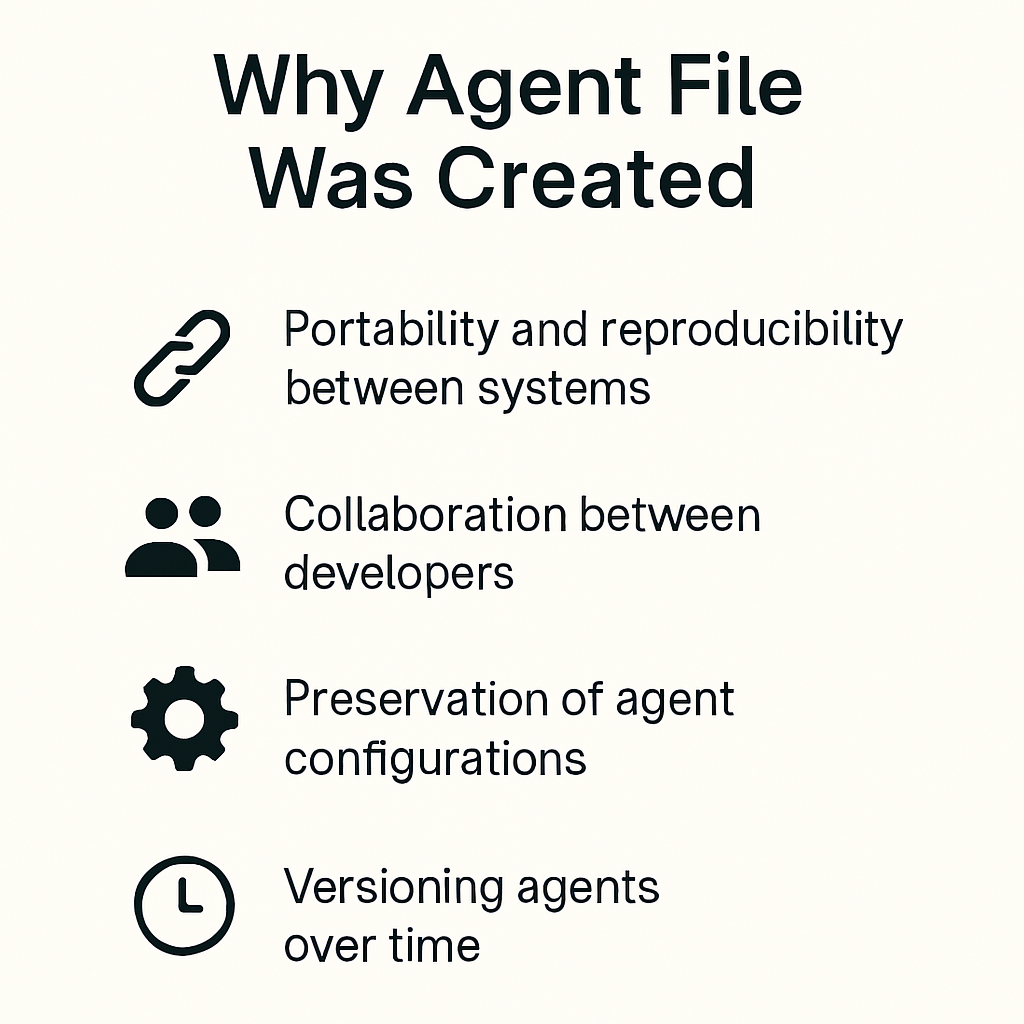
The Agent File (.af) was created to solve this challenge. It acts as a single, unified format that stores all parts of an agent’s configuration and memory. It simplifies how agents are transferred, replicated, and versioned. With Agent File, you no longer have to worry about setting up an agent from scratch on a new system — just load the .af file and you’re ready to go.
This brings much-needed portability, collaboration, and consistency to the world of intelligent AI agents — something that is essential as we move toward more advanced, real-world AI applications.
Things for which agent file created :
🌐 Lack of Portability
Moving agents between systems (local → cloud or between servers) was difficult.
No unified format existed to maintain full agent behavior across platforms.
🔁 No Reproducibility
Developers couldn’t reliably recreate the exact same agent elsewhere.
Results varied based on tool setup, memory state, or configuration.
🤝 Poor Collaboration
Sharing agents with teammates required lengthy setup instructions.
Team members couldn’t easily test, debug, or modify others' agents.
🧠 Memory & Tool Loss
Agents using tools and memory couldn’t preserve their state effectively.
Switching platforms often meant starting from scratch.
📦 No Version Control
Evolving agents over time lacked trackable versioning.
Developers had no standardized way to store and revert changes.
⚙️ Complex Agent Setup
Each agent required manual configuration (tools, models, environment).
High barrier to entry for sharing or deploying functional agents.
3. What can Agent File do?
With Agent File, the possibilities are huge — because now you can create, save, share, and reuse intelligent agents just like software. To show what's possible, the creators of the .af format have shared a few sample agents that you can download and try immediately:
🧠 Deep Research Agent: A stateful agent designed to help you with deep research. It remembers what you’ve read or asked, allowing you to build knowledge over time.
💬 Customer Support Agent: This agent uses memory and tools to provide better answers to customers. It can learn from previous conversations to improve future ones.
🛠️ Workflow Agent: A stateless agent that follows a pre-defined sequence of tasks (tool graph), such as drafting and sending emails — great for productivity.
📜 MemGPT Agents: These are enhanced GPT agents that simulate memory, using advanced prompts from the MemGPT project. You can download them and immediately run them as fully configured agents.
What makes this exciting is that all of these agents are packed into .af files — ready to use, no setup required. You can also create your own agent file, upload it to the community, and let others use your creation. It’s like having a marketplace for shareable AI brains.
4. Why is this important?
The launch of Agent File (.af) is a major step toward building a true AI ecosystem — one where agents are not just single-use tools, but intelligent, evolving systems that can be saved, shared, and improved like software.
Until now, building an advanced AI agent meant configuring environments, loading models, defining tools, managing memory, and writing custom logic — a process that was technical and hard to replicate. Even if someone wanted to share their agent, others would struggle to recreate it the same way.
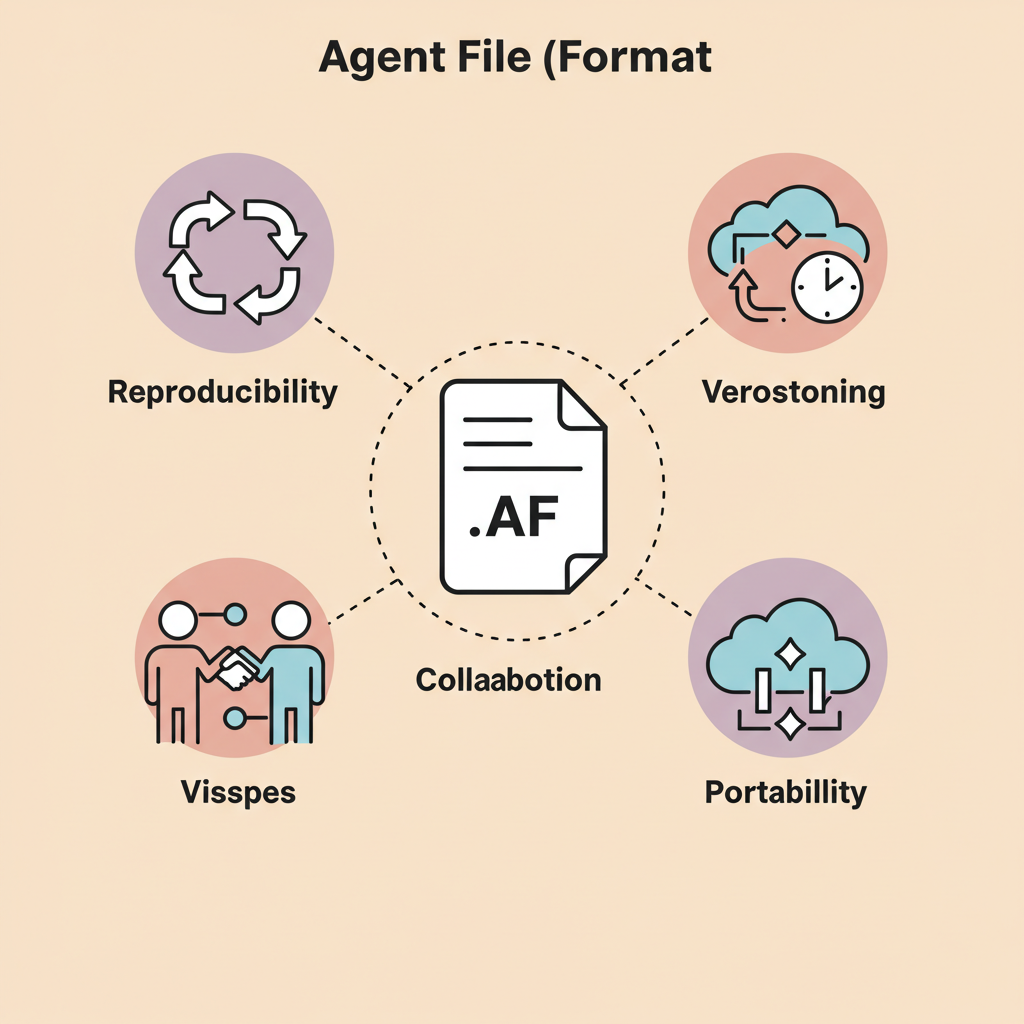
Agent File changes this. It gives us a standard way to define and preserve agentic state, including everything an agent needs to function — from memory and tools to models and behaviors. This enables:
🔄 Reproducibility – Load the same agent anywhere, with the same behavior.
🤝 Collaboration – Share agents between developers or teams easily.
🧬 Versioning – Track how an agent evolves over time and roll back if needed.
🚀 Portability – Move agents between cloud and local environments.
It brings us closer to a world where AI agents can truly learn, adapt, and improve — and where they can be shared like mobile apps or browser extensions.
Agent File is not just a new file format — it’s a foundational piece for building the operating system of AI agents.
5.Conclusion:
The introduction of the Agent File (.af) format marks a turning point in the evolution of AI agents. As we move beyond simple prompt-response systems into a world of autonomous, stateful, and intelligent agents, the need for a structured, shareable format becomes essential. Agent File meets that need by offering a powerful yet simple solution — a single file that stores an agent's memory, tools, configuration, and state in a reproducible way.
This innovation doesn’t just benefit developers — it empowers teams, researchers, and organizations to collaborate more efficiently, scale their agent workflows, and preserve their work with versioning and portability. Developers can now share agents like open-source projects, communities can build libraries of reusable agents, and individuals can fine-tune personal assistants that grow smarter over time.
Agent File lays the foundation for what many believe is the next big leap in AI: the agentic operating system — a platform where agents can evolve, interact, and move freely across cloud, edge, and local environments. It brings us closer to a world where intelligent agents can truly learn from experience, carry context over time, and become persistent digital teammates.
We are just at the beginning of this journey, but the implications are massive. With Agent File, creating and sharing an AI agent becomes as simple as downloading a file — and with that simplicity comes a new wave of innovation, creativity, and possibility.
Whether you're an AI researcher, a developer, or just an enthusiast, Agent File invites you to join the movement. Build your own agent, save it as a .af file, and share it with the world. The future of AI is not just about smarter models — it’s about smarter systems, built together.